
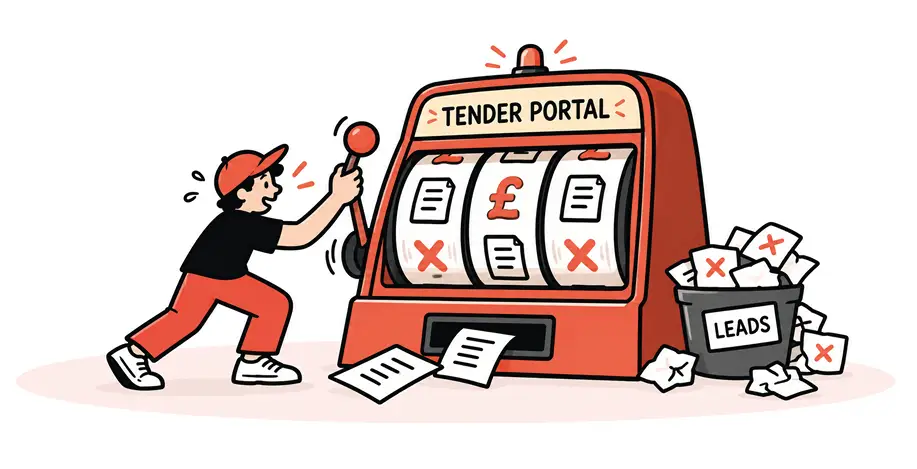
There’s something reassuring about a tender portal.
You log in, search for branding, design or marketing opportunities and find organisations actively looking for agencies. There are budgets, deadlines, specifications and instructions on how to apply.
Unlike speculative new business, somebody has actually said they need help.
But there’s a catch.
Finding an opportunity isn’t the same as having a realistic chance of winning it. And a tender that takes three days to respond to can become an expensive distraction if the odds were against you from the beginning.
So are tender portals worth it for creative agencies?
Yes, provided you’re selective about what you pursue and don’t rely on them as your entire new business strategy.
The question isn’t whether tender portals work. It’s whether they work for your agency, your capabilities and the amount of time you’re prepared to invest.
What are tender portals?
Tender portals are websites where organisations publish contracts and invite suppliers to compete for them.
For creative agencies, that might mean a local authority commissioning a destination brand, a university seeking a website partner or a cultural organisation appointing a marketing agency.
Some portals are operated by government bodies and are free to use. Others are commercial services that aggregate opportunities from multiple sources, offer alerts or provide additional procurement intelligence.
A typical tender notice might include the organisation, contract value, scope of work, submission deadline and evaluation criteria.
That information is useful because it removes some of the uncertainty associated with finding new business.
But it doesn’t tell you everything.
You may not know whether the incumbent is bidding, how many agencies will respond, how well the client understands the creative challenge or whether your agency has the experience needed to score highly.
Those questions can matter more than the headline budget.
Which tender portals should creative agencies use?
There are several established platforms worth knowing about, particularly if you’re targeting public-sector work in the UK.
Find a Tender
Best for agencies pursuing public-sector contracts and larger procurement opportunities.
Find a Tender is the UK’s central digital platform for public procurement notices under the Procurement Act 2023.
It’s free to use and includes tender notices, planned procurement activity, preliminary market engagement and contract award information.
For creative agencies, it can be particularly relevant when looking for larger branding, communications, digital and marketing appointments.
One advantage is that you can research procurement activity before the final tender is published.
The limitation is relevance. The platform covers an enormous range of goods and services, and a search for marketing or design can return opportunities that have little to do with the work your agency wants.
Our view: An essential starting point for agencies serious about public-sector work, but one that requires careful filtering and qualification.
Contracts Finder
Best for discovering additional public-sector opportunities and researching previous contracts.
Contracts Finder is another free government service, providing access to contract opportunities, future opportunities and historic awards.
It remains a useful research resource alongside Find a Tender, although the enhanced Find a Tender platform now plays a broader central role in UK procurement.
For agencies, historic contract information can be particularly interesting.
Rather than simply searching for work available today, you can investigate which organisations have previously commissioned branding, communications or digital services, who won those contracts and when similar requirements might arise again.
The disadvantage is that you’ll still need to separate relevant creative work from the wider procurement market.
Our view: Useful for both live opportunities and background research, particularly when building a list of public-sector organisations you’d like to work with.
Public Contracts Scotland
Best for agencies targeting Scottish public-sector organisations.
Public Contracts Scotland provides access to procurement opportunities from public bodies across Scotland.
For agencies working in destination branding, tourism, culture, local government and public communications, it can be a valuable source of relevant briefs.
Regional knowledge and experience can help, although agencies should always check the actual tender requirements rather than assuming opportunities are restricted to local suppliers.
Our view: Worth monitoring if Scotland is part of your target market.
Sell2Wales
Best for agencies pursuing Welsh public-sector work.
Sell2Wales is the Welsh Government’s procurement advertising platform.
Opportunities can include communications, design, digital services, destination marketing and other work commissioned by public bodies.
It also provides information about buyers and procurement activity, making it useful beyond simply checking current deadlines.
Our view: Particularly relevant to agencies with experience in public-sector communications, culture, tourism and regional development.
eTendersNI
Best for agencies looking for public-sector contracts in Northern Ireland.
eTendersNI is a procurement platform used by Northern Ireland public-sector organisations.
Like the other government services, it can reveal opportunities for agencies with suitable expertise, but you’ll need to assess the procurement requirements and practicalities of delivering the work.
Our view: A useful addition for agencies pursuing work across the whole UK.
BidStats
Best for agencies that want broader tender discovery and procurement research in one place.
BidStats is a commercial tender search and intelligence service offering access to public procurement information.
Its paid plans provide features such as more extensive searches, alerts, historic contract information and procurement research.
That convenience can be valuable if your agency regularly searches across multiple buyers and sectors.
However, it’s worth understanding what you’re paying for. Much of the underlying public procurement information is available through official services at no cost.
You’re paying for the additional search, monitoring, aggregation and research capabilities.
Our view: Potentially worthwhile for agencies with an established tendering strategy, but harder to justify if you only pursue an occasional public-sector brief.
How do the main tender portals compare?
| Platform | Cost to search | Main strength |
|---|---|---|
| Find a Tender | Free | Central UK public procurement and upcoming notices |
| Contracts Finder | Free | Contract searches and historic research |
| Public Contracts Scotland | Free | Scottish public-sector opportunities |
| Sell2Wales | Free | Welsh public-sector opportunities |
| eTendersNI | Free | Northern Ireland public-sector procurement |
| BidStats | Free and paid options | Aggregated searches, alerts and historic intelligence |
For most agencies starting out, the free government portals provide enough information to begin exploring the market.
A paid service becomes more attractive when the time saved researching, filtering and monitoring opportunities justifies the subscription.
But that leads to a more important question.
How much does pursuing a tender actually cost your agency?
The hidden cost of pitching
Imagine an agency discovers a branding tender worth £80,000.
On paper, it’s attractive. The client is established, the work fits the portfolio and the contract could provide several months of revenue.
The team decides to pitch.
A creative director spends a day reviewing the brief and developing an approach. A strategist contributes two days. A designer spends another two days preparing supporting material. The founder handles the commercial response, credentials and final submission.
That’s six days of agency time.
At an illustrative internal opportunity cost of £500 per day, the pitch has consumed £3,000 before anyone has presented anything.
If the agency wins, that investment may be entirely worthwhile.
If it loses, the time is gone.
And if the agency pursues ten similar opportunities with the same level of effort, that’s £30,000 of potential billable capacity committed to pitching.
This doesn’t mean agencies should stop pitching.
It means pitch costs should be treated as a business investment rather than invisible overhead.
How do you know whether a tender is worth pursuing?
A good opportunity should survive some difficult questions before the team commits to a response.
Does the work genuinely fit your agency?
Not simply whether you can deliver it, but whether it’s the kind of work you want to be known for.
Can you demonstrate relevant experience?
Public procurement often places significant weight on evidence, methodology and previous delivery. A brilliant creative idea may not compensate for missing mandatory requirements.
Is the budget commercially attractive?
An £80,000 contract isn’t necessarily an £80,000 creative fee. It might include production, media, third-party costs, travel or ongoing services that reduce the actual value to your agency.
Do you understand the evaluation criteria?
If price carries substantial weight and you’re unlikely to be competitive, that’s important to know before investing several days.
Is there an incumbent?
An existing supplier isn’t necessarily favoured, but understanding the current relationship can help you assess the opportunity.
Can you realistically deliver the work?
Winning a contract that stretches your team beyond capacity can create more problems than it solves.
A useful discipline is to make an explicit bid-or-no-bid decision before starting the proposal.
Sometimes the most commercially sensible decision is not to pitch.
Are paid tender subscriptions worth the money?
They can be, but the subscription fee is rarely the biggest cost.
A service costing a few hundred pounds per year might save several hours of searching each month. For an agency regularly bidding for public-sector work, that’s potentially excellent value.
But a paid subscription doesn’t improve the quality of your proposals, establish your credibility or make unsuitable opportunities worth pursuing.
It can also create a subtle problem.
When you’re paying for a constant stream of tender alerts, there’s a temptation to treat the number of opportunities received as evidence that your new business strategy is working.
It isn’t.
Twenty new alerts mean very little if nineteen are irrelevant and the twentieth is a contract you have almost no chance of winning.
A better measure is the number of genuinely qualified opportunities you identify, the amount of agency time invested and the commercial return from that effort.
If a paid platform consistently saves time and helps you identify suitable contracts, it’s doing its job.
If it simply gives you more things to look at, it may be adding noise rather than value.
The biggest limitation of tender portals
Tender portals are designed primarily around procurement.
They tell you when an organisation has reached a point where it is formally seeking suppliers.
But creative opportunities don’t necessarily begin at that moment.
Consider a developer planning a major regeneration project.
Long before it publishes a destination branding tender, it may have acquired land, secured investment, appointed architects, consulted with local stakeholders and submitted planning applications.
Those developments can indicate that a significant project is moving forward.
The eventual creative requirement might still be months away, and it might never become an externally commissioned project.
But there’s potentially an opportunity for a relevant agency to understand the challenge and begin building a relationship before procurement starts.
The same applies to consumer brands entering new markets, businesses going through mergers and cultural organisations undertaking major redevelopment programmes.
By the time a tender appears, some of the most interesting strategic conversations may already have happened.
That’s why relying exclusively on tender portals can limit an agency’s view of the market.
You’re seeing the opportunities organisations have chosen to advertise, rather than the wider range of business developments that might eventually create creative work.
Can you approach an organisation before it publishes a tender?
Yes, although the context matters.
For private-sector organisations, a relevant introduction based on a genuine business development can be a sensible way to start a relationship.
For public-sector organisations, procurement rules, transparency and equal-treatment requirements must be respected.
Public buyers may conduct preliminary market engagement before publishing a tender, and formal notices can provide opportunities to understand future requirements.
But agencies shouldn’t assume that early contact gives them an advantage in a subsequent competitive process.
The purpose of engaging early should be to understand the organisation and contribute relevant expertise, not to circumvent procurement.
If you’d like to explore this approach in more detail, read How to approach a client before a brief exists.
Tender portals versus early-stage opportunity intelligence
These two approaches serve different purposes.
A tender portal helps you find work that an organisation has decided to procure.
Early-stage opportunity intelligence helps you identify business developments that could lead to creative requirements before a formal brief exists.
| Tender portals | Early-stage intelligence | |
|---|---|---|
| Typical timing | Formal procurement stage | Before a brief may exist |
| Scope | Defined requirements | Potential or emerging requirements |
| Budget | Often published or indicated | May require estimation |
| Competition | Other suppliers can access the same notice | Opportunity may be less widely recognised |
| Main challenge | Winning a competitive process | Establishing relevance and timing |
| Main advantage | Clear buying intent | Potential to build relationships earlier |
Neither approach is inherently superior.
A live tender gives you greater certainty that an organisation is actively seeking suppliers, although you may face significant competition.
An early-stage signal offers less certainty that work will materialise, but may give you more time to develop a relevant relationship.
The strongest new business strategies can accommodate both.
What should a creative agency’s tender strategy look like?
Start by deciding what kinds of work you actually want.
That sounds obvious, but it’s easy to abandon those criteria when the pipeline becomes quiet.
An agency specialising in cultural branding shouldn’t necessarily pursue every marketing tender with an attractive budget. A digital studio shouldn’t automatically respond to a large technology contract simply because website development appears somewhere in the specification.
Define your target sectors, minimum commercially viable project value, relevant capabilities and the kinds of client relationships you want.
Then establish a regular process for reviewing opportunities.
That might involve checking relevant portals each week, monitoring procurement activity from target organisations and reviewing early-stage developments in your chosen sectors.
The important thing is consistency.
New business becomes much harder when research only starts after a major client project finishes.
Finally, measure what happens.
Track the opportunities reviewed, bids submitted, time invested, shortlisted pitches, contracts won and revenue generated.
After several months, you’ll have a much clearer picture of whether tendering is an effective route to market for your agency.
And you may discover that your best opportunities come from somewhere else entirely.
So, are tender portals worth it?
For many creative agencies, absolutely.
They’re an accessible way to discover organisations actively commissioning work, and the official UK platforms provide a substantial amount of information for free.
For agencies with strong public-sector experience, relevant credentials and the capacity to prepare competitive submissions, tenders can be an important source of revenue.
But tender portals shouldn’t be mistaken for a complete new business strategy.
They reveal only part of the market, and finding more briefs doesn’t automatically mean winning more work.
The real objective is to build a pipeline of opportunities that suit your agency, arrive at the right time and justify the effort required to pursue them.
Sometimes that opportunity will be a published tender with a clear deadline.
Sometimes it will be a conversation that begins six months before anyone writes a brief.
The skill is knowing which deserves your attention.