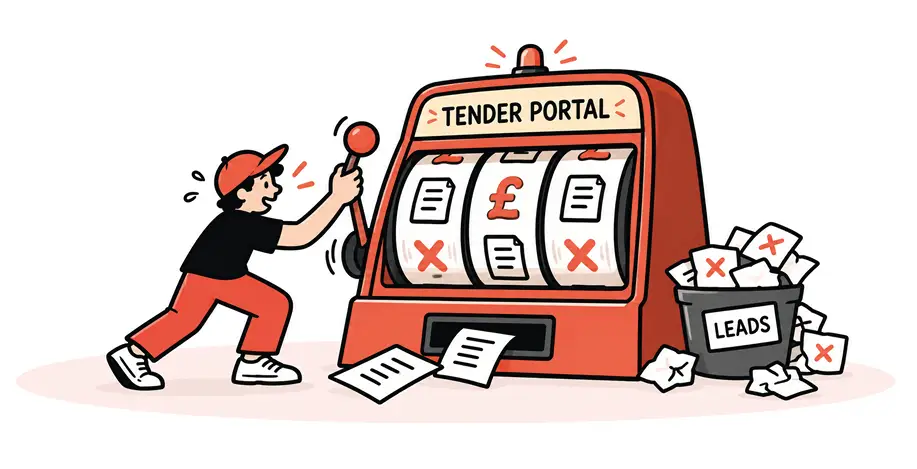

There’s a particular kind of anxiety that comes with running a creative agency.
The studio is busy today. Everyone has work on their desks. Clients are happy, projects are progressing and the invoices are going out.
But you look three months ahead and things are a little less reassuring.
A couple of projects are due to finish. One client hasn’t confirmed their next campaign. Another has gone quiet. There’s nothing particularly alarming, but there isn’t much certainty either.
Then a pitch opportunity lands.
It’s not quite the sort of work you want. The budget is a little low. The deadline is ridiculous. And under normal circumstances, you probably wouldn’t give it much consideration.
But the pipeline is looking thin.
Suddenly, it seems more interesting.
So should you pitch?
The answer isn’t necessarily no. Some of the best agency relationships begin with taking a chance on an unexpected opportunity.
But there’s an important difference between pitching because you’re hungry for growth and pitching because you’re hungry for work.
Understanding that difference can save an agency a considerable amount of time, money and frustration.
Why a quiet pipeline changes your judgement
When an agency has a healthy pipeline, it’s easier to be selective.
You can assess a brief against your capabilities, the client’s ambitions, the available budget and the likelihood of building a worthwhile relationship.
If it doesn’t fit, you can walk away.
When the pipeline is quiet, those same criteria can become surprisingly flexible.
A £30,000 project that would normally feel too small suddenly looks attractive. A client in an unfamiliar sector becomes an opportunity to diversify. A complicated procurement process seems worth the effort because, well, what else is coming in?
None of those decisions is automatically wrong.
The problem is that the agency’s need for revenue can begin to influence its assessment of the opportunity itself.
You stop asking whether the work is right for the business and start asking whether you can afford not to pursue it.
That’s a dangerous position from which to make commercial decisions.
Pitching isn’t a sign of desperation
There’s a tendency to talk about pitching as though it’s something successful agencies eventually grow out of.
They don’t.
Plenty of established agencies continue to pitch regularly, even when they have strong client relationships and substantial retained work.
And there are good reasons for that.
A pitch can introduce an agency to a new sector, open the door to a significant client or create the kind of opportunity that changes the direction of the business.
There’s also something genuinely exciting about the process.
A new brief arrives. The team gathers around a table. Ideas start developing. Someone spots an unexpected angle. Suddenly there’s the possibility of producing work the agency hasn’t had the opportunity to create before.
That energy is part of what makes running a creative business enjoyable.
Pitching can be ambitious, creative and commercially sensible.
The issue isn’t how often an agency pitches.
It’s whether the agency is choosing those opportunities or simply reacting to whatever comes along.
The real cost of pitching for everything
Consider a small creative agency with a team of ten.
A branding opportunity arrives with an estimated fee of £60,000.
The founder likes the organisation. The team could deliver the work. The client has invited six agencies to participate.
The agency decides to pitch.
Over the following two weeks, the creative director, strategist and design team spend a combined eight days researching, developing ideas, preparing credentials and putting the presentation together.
At an illustrative opportunity cost of £500 per day, that’s £4,000 of agency capacity.
If the agency wins, the investment may be justified.
If it loses, that capacity has been spent.
Now imagine the agency does this five times over three months.
That’s £20,000 of potential billable capacity invested in pitching, before accounting for travel, external costs or the founder’s time.
Of course, not every hour would otherwise have been billable. The true financial cost depends on workload and staffing.
But the time has still been consumed.
And perhaps more importantly, the team has spent weeks working on opportunities that may have had very little chance of converting.
The question isn’t whether pitching costs money.
It’s whether the expected return justifies the investment.
A big budget doesn’t necessarily mean a good opportunity
It’s easy to be distracted by the headline value of a project.
A £150,000 branding brief looks more attractive than a £25,000 website project.
But the larger opportunity might require capabilities you don’t have, involve a lengthy procurement process or demand a level of servicing that makes the work less profitable than it first appears.
The smaller project might come from a growing organisation with a clear requirement, an accessible decision-maker and the potential for a long-term relationship.
The contract value tells you what the opportunity might be worth.
It doesn’t tell you whether it’s worth pursuing.
You need to consider the commercial reality behind the number.
How much of the budget is actually agency fee? How much delivery time will it require? Are there significant third-party costs? Will it disrupt existing commitments? Is there a realistic chance of winning?
A large project with poor margins can be less valuable than a smaller, well-managed relationship.
And a prestigious client isn’t automatically a profitable one.
Five questions to ask before agreeing to pitch
When the pipeline is quiet, a simple qualification process can prevent decisions being driven entirely by anxiety.
1. Would we want this work if the studio were fully booked?
This is probably the most revealing question.
Imagine your agency has three months of confirmed work ahead.
Would you still be interested in the opportunity?
If the answer is yes, there’s probably something genuinely attractive about it.
If the answer is no, ask what’s changed.
Sometimes accepting less-than-ideal work is a rational response to a temporary revenue gap. But it’s important to recognise that decision for what it is, rather than convincing yourself the project is suddenly a perfect strategic fit.
2. Do we have a credible reason to win?
Being capable of delivering the work isn’t the same as being well placed to win it.
Does your agency have relevant experience? Do you understand the client’s sector? Can you demonstrate that you’ve solved similar challenges?
Have you had a meaningful conversation with the organisation, or are you responding to a brief alongside several agencies that may already know the client?
You don’t need an existing relationship to win.
But you should be able to articulate why the client might choose you over the alternatives.
If the only answer is that you’ll produce a brilliant creative response, you may be underestimating the competition.
3. Is the budget genuinely worthwhile?
Look beyond the advertised figure.
Estimate the resources needed to deliver the project, the likely margin and the opportunity cost of committing your team.
Consider payment terms, potential scope changes and whether the work could create further opportunities.
If the budget doesn’t support the work required, winning the pitch may be the beginning of the problem rather than the solution.
4. Do we understand the client’s decision-making process?
Who will make the appointment?
What matters most to them? Is there an incumbent? How many agencies are competing? Is the selection based primarily on price, credentials, strategic thinking or creative proposals?
A client may not be able to answer every question.
But if you have almost no understanding of how the decision will be made, you’re committing resources with limited information.
5. What happens if we win?
This question is often overlooked.
Winning a major project sounds fantastic until you realise it needs to begin in two weeks, overlaps with existing commitments and requires capabilities you were planning to hire later in the year.
A pitch should be assessed against the agency’s ability to deliver the work successfully, not just its desire to secure the fee.
Sometimes the wrong win can be more damaging than a sensible loss.
When taking a chance is the right decision
Not every good opportunity passes a neat qualification checklist.
Some of the most rewarding agency relationships begin with a project that looks unlikely on paper.
A business outside your usual sector might offer the chance to develop valuable new expertise.
A smaller initial commission could become the beginning of a substantial client relationship.
An ambitious brief might stretch the agency creatively in exactly the direction it wants to grow.
And sometimes the team simply feels that an opportunity is worth pursuing.
That instinct has value.
Creative businesses aren’t built entirely through spreadsheets and probability calculations.
But there’s a difference between taking a calculated risk and ignoring the warning signs because you need the revenue.
A calculated risk has a clear reason behind it.
Perhaps you’re deliberately entering a new market. Perhaps the client offers exceptional long-term potential. Perhaps the project would strengthen the portfolio in a way that supports your wider strategy.
You understand what you’re risking and why.
Desperation is different.
Desperation makes almost any opportunity look better than having no opportunity at all.
What should agencies do when the pipeline is genuinely quiet?
The instinct is often to increase activity.
More emails. More LinkedIn messages. More networking. More tender searches. More pitches.
And sometimes that additional effort is necessary.
But increasing the volume of new business activity without improving its quality can simply create more work for the same disappointing results.
A better starting point is to examine the pipeline itself.
Where has your best work come from historically? Which clients are likely to commission more? What types of opportunities convert most consistently? Which sectors are showing signs of investment or growth?
Then focus your efforts accordingly.
Existing clients and former contacts may provide the fastest route to a meaningful conversation.
Referrals and partnerships can open doors where trust already exists.
Relevant live tenders can offer defined opportunities with clear buying intent.
Early-stage business signals can help identify organisations that may need creative expertise in the coming months, even if they haven’t written a brief yet.
The objective is to improve the quality of the pipeline, not simply make it look busier.
Why agencies need to find opportunities before they need them
One of the hardest things about agency new business is that the results rarely arrive when you want them.
A conversation today might become a project in six months.
An introduction might lead nowhere initially, then turn into an enquiry after a leadership change.
A development project might take a year to reach the point where external creative support is required.
That makes new business difficult to manage reactively.
If you only begin prospecting when the studio is quiet, you’re often starting conversations that won’t produce revenue until well after the gap you’re trying to fill.
And that pressure can push you towards whatever work is immediately available.
A more resilient agency maintains a level of new business activity even when the studio is busy.
Not necessarily constant pitching.
But consistent research, relationship development, relevant outreach and monitoring of opportunities.
That creates a pipeline with different stages of maturity.
Some prospects are ready to commission work. Others are exploring their options. Some are simply organisations worth getting to know.
The agency isn’t dependent on every conversation turning into an immediate project.
And when an unexpected gap appears, there’s already something to work with.
Should you ever pitch just to keep the team busy?
Sometimes an agency has to make pragmatic decisions.
There are salaries to pay, overheads to cover and people whose livelihoods depend on the business remaining viable.
Turning down commercially acceptable work because it doesn’t perfectly match the agency’s ambitions can be just as damaging as chasing everything.
If a project generates a worthwhile contribution, can be delivered well and doesn’t create unacceptable risks, taking it may be entirely sensible.
The important thing is to distinguish between a short-term commercial decision and a long-term business strategy.
Accepting a less exciting project to protect cash flow is one thing.
Building an agency around repeatedly winning work you don’t particularly want is another.
Over time, that can shape the portfolio, reputation and type of clients who approach you.
You become known for the work you keep accepting.
Which means every pitch decision has consequences beyond the immediate fee.
A healthy pipeline gives you the freedom to say no
One of the less obvious benefits of consistent new business development is that it changes how an agency behaves.
When you have several promising conversations underway, you’re less likely to accept unreasonable deadlines, poor budgets or unsuitable projects.
You’re more comfortable asking difficult questions.
You can negotiate from a stronger position.
And you can pursue opportunities because they genuinely interest you, rather than because you’re worried about what happens if nothing else comes along.
That doesn’t mean the pipeline needs to be overflowing.
It means having enough visibility of potential future work to make decisions without every opportunity feeling like the last one.
The irony is that agencies often produce their best pitches when they don’t desperately need to win them.
They’re more confident, more selective and more willing to challenge the brief.
They behave like a creative partner rather than a supplier trying to secure the next invoice.
So, should you pitch when the pipeline is quiet?
Yes, if the opportunity deserves your time.
A quiet pipeline shouldn’t automatically disqualify an interesting brief, just as a busy studio shouldn’t prevent you from pursuing a potentially transformative client.
But it should make you more conscious of why you’re making the decision.
Are you genuinely excited by the organisation, the challenge and the potential relationship?
Can you deliver the work profitably?
Do you have a credible chance of winning?
Or are you simply uncomfortable with the uncertainty of what’s coming next?
There’s nothing wrong with being hungry for work. Every agency owner understands that feeling.
The danger is allowing that hunger to make every opportunity look like a good one.
Because the objective isn’t to pitch more.
It’s to build an agency that can choose what it pitches for.