
There’s a familiar moment in agency new business. A brief arrives, the opportunity looks promising, the budget is attractive and everyone starts discussing whether to pitch.
By that point, however, the client may already have spoken to three other agencies. They may have an incumbent they trust, a preferred supplier in mind or a fairly clear idea of what the answer should look like.
You’re not necessarily too late to win. But you’re entering a conversation that’s already underway.
What if you’d known about the project six months earlier?
That’s the opportunity behind approaching a prospective client before a formal brief exists. Not to sell them something they don’t need, but to start a useful relationship while they’re still working out what they need.
Why waiting for the brief puts agencies at a disadvantage
Formal briefs serve an important purpose. They establish requirements, budgets, deliverables and a process for selecting a partner.
But they also change the nature of the conversation.
Once a client has written a brief, much of the thinking has already happened. Someone has identified the problem, discussed possible solutions, secured internal approval and decided what kind of agency they believe they need.
Your role is largely to respond to that thinking.
Earlier in the process, the questions are often more interesting.
What should this new destination stand for? How will customers understand the merger? Does the existing brand still reflect where the business is heading? How should the organisation communicate a major change?
These aren’t necessarily questions with a brief attached. They’re business challenges that could eventually become creative projects.
An agency that enters the conversation at this stage has an opportunity to contribute its expertise before the scope of work has been defined.
That doesn’t guarantee an appointment. But it can create a very different relationship from being one of six agencies responding to the same document.
What makes a good reason to get in touch?
The biggest mistake agencies make with early outreach is confusing an interesting company with an actual opportunity.
You might admire a brand, love its products or think its website needs work. None of those things necessarily gives its leadership a reason to speak to you.
A stronger approach starts with evidence that something is changing.
Consider a few examples.
A property developer secures planning permission. A major mixed-use development is moving closer to delivery. At some stage, it may need destination positioning, placemaking, stakeholder communications or a public-facing identity.
Two businesses announce a merger. Their leadership teams may need to consider how the combined organisation presents itself, communicates with customers and brings employees together.
A food brand enters a major retailer. New distribution can create pressure around packaging, product architecture, campaigns and how the brand stands out on a crowded shelf.
A cultural organisation announces a major redevelopment. Beyond the building itself, there may be questions around audience development, visitor experience, fundraising and communications.
None of these announcements automatically means an agency appointment is coming.
But each provides a credible reason to investigate.
The distinction matters. You’re not claiming to know that work exists. You’re recognising a business development that could create a need for creative expertise.
Find the right moment, not just the right company
Timing can make the difference between a welcome conversation and an irrelevant sales email.
Contact an organisation too early and there may be nothing meaningful to discuss. Contact it too late and the agency selection process may already be underway.
The useful window is often when a business has made a significant commitment but hasn’t necessarily decided how to communicate, position or deliver it.
Planning approval is one example. Funding announcements, acquisitions, leadership appointments, expansion plans and major partnerships can create similar moments.
The challenge is that these signals rarely arrive labelled as creative opportunities.
They appear in planning documents, annual reports, local news, investor announcements, company updates and industry publications.
Finding them requires looking beyond the places agencies traditionally search for work.
And interpreting them requires judgement.
A £200 million regeneration project doesn’t mean there’s a £200 million branding opportunity. Equally, a relatively modest business announcement could lead to a substantial creative relationship.
The question isn’t simply how big the announcement is.
It’s whether the change creates a problem your agency is genuinely equipped to help solve.
Who should you approach?
Finding a promising project is only half the challenge. You then need to work out who is likely to influence the decisions.
For a destination development, that could be someone responsible for marketing, development, placemaking or commercial strategy.
For a growing consumer brand, it might be the founder, marketing director or brand lead.
For an organisational transformation, the relevant contact could sit in communications, strategy or senior leadership.
The most senior person isn’t automatically the best person.
You want someone close enough to the challenge to understand why your perspective might be useful, and sufficiently involved to influence what happens next.
That usually means doing a little more research than finding a generic marketing email address.
It also means accepting that the first person you contact may not be the decision-maker. Sometimes the most valuable outcome is simply being introduced to the person responsible.
What should you actually say?
This is where many agencies undermine otherwise good research.
They find a relevant opportunity, identify a contact and then send an email that sounds remarkably like every other agency introduction.
We’re an award-winning creative agency specialising in brand strategy, digital experiences and integrated campaigns. We’d love to arrange a call to introduce ourselves.
There’s nothing particularly wrong with that. There’s just very little reason for the recipient to respond.
A better introduction starts with what’s happening in their world, not yours.
Imagine a developer has recently secured planning approval for a major town-centre transformation.
You might write:
I saw that planning has now been secured for the town-centre development. The challenge of creating a destination that brings together new homes, retail, culture and public space feels particularly interesting.
We work across place branding and destination experience, and had a few thoughts about how the identity and story could begin taking shape as the project moves forward.
Would it be worth a conversation?
It’s short. It’s relevant. And it demonstrates that you’ve taken an interest in the project rather than simply adding another name to a prospecting list.
Importantly, it doesn’t pretend there’s an open brief.
You’re offering a perspective, not demanding an opportunity.
Should you share ideas before being appointed?
There’s a balance to strike.
Showing that you’ve thought about a client’s challenge can make an introduction considerably more compelling. But producing a speculative brand strategy, campaign concept or design presentation for someone who hasn’t requested it is rarely a sensible use of agency time.
At this stage, your objective isn’t to solve the entire problem for free.
It’s to demonstrate that you understand the problem well enough to have a useful conversation.
That might mean highlighting a challenge the organisation will need to consider, referencing a relevant project you’ve delivered or asking a question that shows you’ve understood the commercial context.
Save the substantial creative work for when there’s a genuine opportunity, a defined relationship and an appropriate commercial arrangement.
What if they aren’t ready?
Often, they won’t be.
The project might be months away. The budget may not exist yet. Responsibility for the work may still be undecided.
That doesn’t necessarily make the approach unsuccessful.
One of the advantages of engaging early is that you have time to develop a relationship without the pressure of an immediate pitch.
A useful first conversation might lead to an introduction, a request to share relevant work or permission to reconnect when the project progresses.
The important thing is to follow up for a reason.
If the project receives funding, enters a new phase or appoints a leadership team, that’s a natural opportunity to reconnect.
Repeatedly asking whether they have any work available is not.
Early-stage new business requires patience. Some conversations won’t go anywhere. Others may develop into opportunities months later.
The challenge is building a pipeline that allows for both.
Is approaching clients before a brief always better?
No.
Some organisations must follow formal procurement procedures, particularly in the public sector. Early engagement doesn’t remove those obligations, and agencies should never assume that a relationship gives them preferential treatment.
Some businesses already have established agency partners. Others simply won’t have a relevant requirement.
And there are plenty of occasions when a well-written tender represents an excellent opportunity.
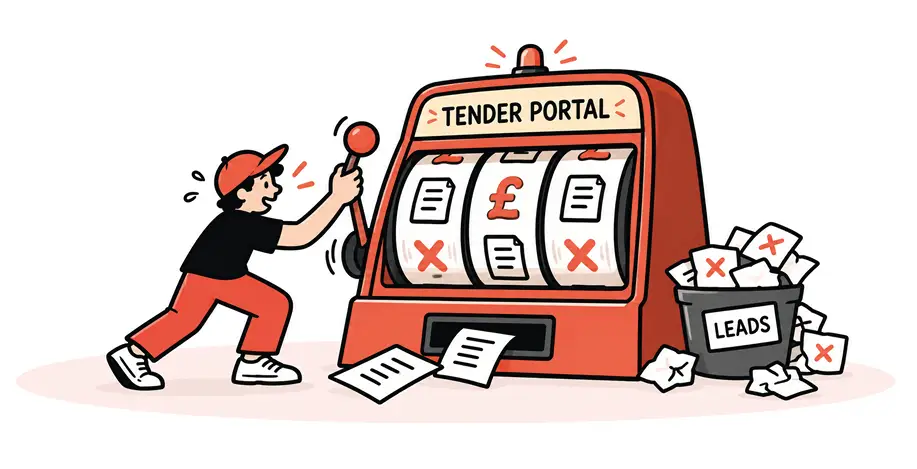
The point isn’t to abandon pitching or tender portals.
It’s to avoid making them your only source of new business.
A healthy agency pipeline can include referrals, existing relationships, inbound enquiries, formal tenders and conversations initiated long before a brief exists.
The more varied those sources, the less dependent you become on waiting for someone else to announce that they’re ready to buy.
The real advantage is having a reason to start
Most agency owners could probably name 20 organisations they’d love to work with.
The harder question is why any of those organisations should speak to them this week.
That’s what early opportunity intelligence can provide.
A reason.
A business change, a significant investment, a new direction or an emerging challenge that creates a natural opening for a relevant conversation.
It doesn’t replace good creative work, strong relationships or the ability to sell your agency.
But it gives those capabilities somewhere useful to start.
And perhaps that’s the biggest difference between chasing briefs and developing new business.
One begins when someone asks agencies to get in touch.
The other begins when you’ve spotted a good reason to make the first move.