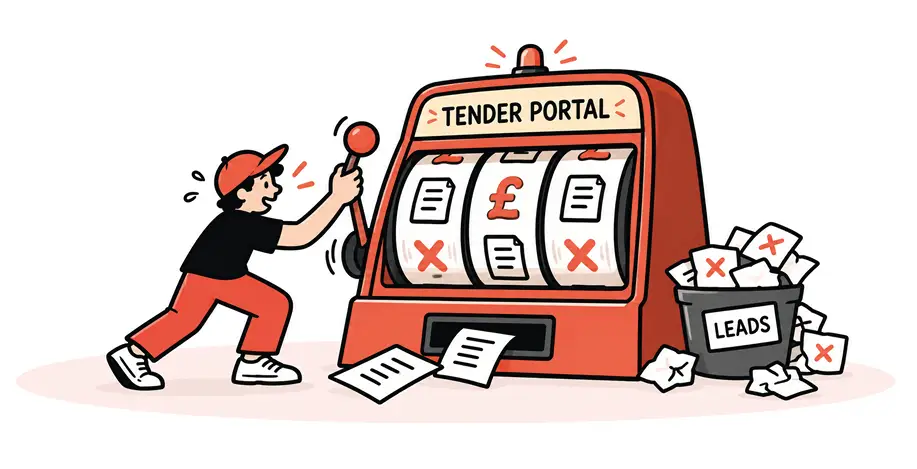

Ask ten agency owners where their best clients came from and you’ll probably hear ten different stories.
A referral from an old colleague. A chance introduction at an event. A speculative email that happened to land at exactly the right moment. A pitch they nearly turned down.
Very few will tell you that their biggest client came from a carefully planned new business strategy that unfolded exactly as expected.
And that’s part of the problem.
Creative agencies are often very good at winning work when the right opportunity appears. They’re less consistent at making sure those opportunities appear in the first place.
When the studio is busy, new business slips down the list. When projects finish and the pipeline looks thin, everyone suddenly starts looking for the next thing.
The solution isn’t necessarily to spend more time selling. It’s to build a more reliable way of identifying opportunities before you urgently need them.
Here are ten places worth looking, including some that agencies routinely overlook.
1. Existing clients
Before spending money trying to find new clients, consider whether you’re making the most of the ones you already have.
An agency might be commissioned to redesign a website without ever discussing the client’s wider digital strategy. A brand identity project might conclude just as the organisation begins planning a major campaign.
The work is finished, the invoice is paid and everyone moves on.
Yet the people you’ve already worked with know your capabilities, understand how you operate and have experienced the quality of your work.
That gives you a considerable advantage over an agency approaching them for the first time.
Regular conversations about where the business is heading can reveal requirements that haven’t yet become formal projects.
Best approach: Make time for conversations about your clients’ next 12 months, not just their current deliverables. Ask what’s changing, what they’re planning and where they’re encountering challenges.
2. Referrals and professional relationships
Referrals remain one of the most valuable sources of agency work because they arrive with an element of trust already established.
A recommendation from a respected colleague can open a door that dozens of speculative emails wouldn’t.
But referrals are also unpredictable.
You can’t control when a former client changes jobs, when a contact recommends you or when someone in your network hears about a relevant project.
What you can control is how well you maintain those relationships.
Former clients, freelancers, consultants, developers, production partners and even other agencies can all become sources of introductions.
The mistake is only getting in touch when you need work.
Best approach: Keep relationships alive without constantly asking for business. Share relevant thinking, make useful introductions and stay interested in what people are doing.
3. Early-stage business signals
Some of the most interesting creative opportunities begin long before an organisation starts looking for an agency.
A developer secures planning permission for a new destination. A consumer brand announces expansion into a major retailer. Two businesses merge. A cultural organisation receives funding for a redevelopment.
None of these announcements is necessarily a creative brief.
But each could create a requirement for branding, communications, packaging, digital experiences or campaigns.
These are early-stage business signals.
The advantage is timing. Instead of competing for a brief that’s already circulating, an agency can investigate whether there’s a relevant challenge and potentially begin a conversation while the organisation is still considering its options.
The difficulty is finding the right signals among thousands of announcements that have little or no creative relevance.
Best approach: Follow developments in the sectors you want to work in. Look for meaningful changes, committed investment and clear business challenges rather than simply collecting company news.
4. Live tenders and procurement portals
Tender portals are an obvious place to look because the organisations advertising work have already identified a requirement.
There’s usually a scope, deadline, procurement process and some indication of budget.
For agencies with the right experience, particularly those working with public-sector organisations, cultural institutions and larger businesses, tenders can provide access to substantial opportunities.
But there’s a trade-off.
By the time a tender is published, the client may have already defined the solution, established the evaluation criteria and decided how the appointment will be made.
You’ll also be competing with other agencies that have access to the same information.
And responding properly can be expensive.
A tender that looks attractive at first glance may require days of preparation, extensive compliance documentation and evidence of experience your agency doesn’t possess.
Best approach: Qualify tenders before committing resources. Consider the budget, requirements, competition, evaluation criteria and your realistic likelihood of winning.
A live opportunity isn’t automatically a good opportunity.
5. Company expansion and investment announcements
Businesses that are growing often face challenges that creative agencies are equipped to solve.
A manufacturer entering a new market may need to reconsider its brand positioning. A hospitality group opening multiple locations may need a more consistent identity. A technology business receiving investment may need to communicate a more ambitious proposition.
The announcement itself rarely spells out the creative requirement.
That’s where an agency’s commercial understanding becomes valuable.
Rather than contacting every business that raises money, look at what the investment is intended to achieve.
Is the company entering a new category? Targeting a different audience? Launching products? Expanding internationally?
Those details help establish whether there might be a credible reason to start a conversation.
Best approach: Follow funding, acquisitions, expansion and investment activity within your target sectors. Focus on what the business plans to do next, not simply the amount of money announced.
6. Planning applications and regeneration projects
For agencies working in place branding, destination marketing, property, culture and the built environment, planning activity can be an unusually useful source of intelligence.
Major developments often progress through years of consultation, planning, funding and delivery before the public experiences the finished destination.
Across that journey, organisations may need support with stakeholder engagement, identity, positioning, marketing, wayfinding and communications.
Local authority planning portals, development frameworks, regeneration announcements and property industry publications can reveal projects well before creative appointments are publicly advertised.
But scale doesn’t automatically translate into opportunity.
A £500 million development doesn’t mean there’s a large branding budget available, or that the developer intends to appoint an external agency.
Best approach: Identify projects with clear momentum, understand who’s responsible for delivery and investigate where creative expertise might become relevant.
7. Leadership changes and organisational transformation
When a new chief executive, marketing director or brand leader joins an organisation, priorities can change.
Sometimes that means reviewing suppliers. Sometimes it means repositioning the business, changing its communications or accelerating projects that had previously stalled.
Equally, a new appointment might change very little.
The opportunity isn’t the personnel announcement itself. It’s what the appointment might signal about the organisation’s direction.
A new marketing director recruited to lead international growth presents a different prospect from someone appointed to maintain an established operation.
The same principle applies to mergers, restructures and significant changes in ownership.
Best approach: Read beyond the appointment headline. Look at the responsibilities, stated ambitions and business challenges behind the change.
And resist the temptation to send a generic congratulatory email followed immediately by an agency pitch.
8. LinkedIn and industry conversations
LinkedIn can be useful for finding new business, but not necessarily in the way agencies are often encouraged to use it.
Publishing regularly doesn’t automatically create a pipeline.
What LinkedIn does provide is visibility into what organisations and decision-makers are discussing.
Founders talk about growth. Marketing directors share product launches. Developers announce milestones. Cultural leaders discuss funding and audience challenges.
These conversations can reveal what matters to prospective clients before a formal requirement appears.
They can also help you develop familiarity with the people and organisations you’d like to work with.
The important distinction is between being visible and being relevant.
An agency can post every day and still fail to connect with the businesses it wants to reach.
Best approach: Follow a defined list of target organisations and decision-makers. Pay attention to their business challenges, contribute where you have something useful to say and use genuine developments as reasons to start conversations.
9. Partnerships and complementary agencies
Not every opportunity needs to come directly from an end client.
A brand agency may need a specialist digital partner. A web development studio may encounter clients requiring positioning or identity work. A communications consultancy may need creative production capabilities.
These relationships can generate opportunities that would otherwise be difficult to access.
They can also allow smaller agencies to compete for work that requires a broader combination of skills.
The strongest partnerships are built around complementary expertise rather than two businesses offering exactly the same services.
But expectations need to be clear.
Who owns the client relationship? How will responsibilities be divided? Who manages the work? What happens if the client wants to engage one partner directly?
Best approach: Build a small network of trusted specialists whose capabilities genuinely complement yours. Establish how referrals and joint projects will work before an opportunity arrives.
10. Your own website and searchable expertise
One of the more overlooked sources of new business is the agency’s own website.
Not simply as a portfolio, but as a place where prospective clients can find useful answers to the questions they’re already asking.
A destination developer might search for advice on place branding. A founder preparing to launch a product might want to understand packaging design costs. A marketing director might be comparing website platforms or wondering what a rebrand involves.
If your agency provides a genuinely useful answer, you’ve created an opportunity to be discovered before the client has decided who to appoint.
This is the thinking behind Marcus Sheridan’s They Ask, You Answer approach.
Rather than publishing endless agency news and awards, answer the questions prospective clients care about, including the difficult ones around cost, problems, alternatives and whether a particular service is right for them.
The challenge is that inbound marketing takes time.
Publishing five articles won’t suddenly fill the pipeline. Building search visibility requires useful content, technical foundations, credibility and consistency.
Best approach: Start with the questions your clients repeatedly ask during enquiries, meetings and pitches. Answer them clearly, using real experience rather than generic marketing language.
Which new business sources actually work best?
There isn’t a universal answer.
An established agency with strong client relationships may generate most of its revenue through referrals and repeat business.
A specialist public-sector consultancy might rely heavily on procurement frameworks and tenders.
A smaller branding studio targeting ambitious consumer businesses might find more value in tracking product launches, investment and expansion.
The right mix depends on your expertise, reputation, target market and appetite for pitching.
But there is a useful distinction between the sources you can influence and those you largely have to wait for.
| Source | Main advantage | Main limitation |
|---|---|---|
| Existing clients | Established trust | Limited to current relationships |
| Referrals | Warm introductions | Unpredictable timing |
| Early-stage signals | Potential to engage before a brief | Requires research and judgement |
| Live tenders | Defined requirements | Competition and pitch costs |
| Investment announcements | Evidence of business change | Creative need may be uncertain |
| Planning and regeneration | Long-term project visibility | Extended timelines |
| Leadership changes | Potential shift in priorities | No guaranteed requirement |
| Direct insight into organisations | Time-intensive | |
| Partnerships | Access to complementary expertise | Dependence on partners |
| Website and SEO | Inbound discovery | Takes time to build |
The strongest approach is usually a combination.
Existing relationships and referrals provide a foundation. Inbound content helps organisations discover you. Tenders offer defined opportunities. Early-stage research gives you a way to start conversations rather than waiting for them.
Together, they create a pipeline that’s less dependent on any single source.
The problem isn’t finding companies. It’s finding reasons to approach them.
Most agency owners don’t struggle to name businesses they’d like to work with.
They struggle to identify which of those businesses might have a genuine reason to need their services, who they should speak to and when the conversation would be most relevant.
That’s why buying another database of company names rarely solves the underlying problem.
You can have thousands of contacts and still have no meaningful reason to email any of them.
The more useful question is:
What’s happening in this organisation that makes a conversation worth having now?
Answering that requires more than a list.
It requires research, context, timing and an understanding of how business developments can translate into creative opportunities.
And that should be the foundation of a more consistent new business strategy.